
By Jolian Lu · SEO Manager, Rivta
Choosing a toiletry bag layout is not simply a question of how many pockets look useful. The layout has to match the product set, the way the user reaches for each item, and the way the bag will be packed, cleaned and checked. A fixed divider can keep the interior orderly with fewer loose parts. A removable inner pouch can separate a group of items and move independently. Each route solves a different handling problem.
Start with the contents and the handling task
Before asking for pockets, send the supplier a content map. It should name the intended items, their approximate dimensions, whether they stand upright or lie flat, and which items should be isolated. If the final contents are unavailable, use representative bottles and tools with the same shape and filled weight for the sample review.
A useful content map answers four questions:
- Which items are used first and should be reachable without unloading the bag?
- Which items must remain upright, and which can move?
- Is there a group that the user should be able to lift out as one unit?
- Which surfaces may need to be wiped or cleaned more often than the rest of the bag?
This step prevents a common failure: approving a neat pocket drawing that cannot hold the real product set. Pocket count is only a label. The buyer needs to confirm opening width, usable depth, access with neighboring pockets filled, and the effect of the contents on the closed bag.
For a broader list of dimensions, materials, logo, packing and approval fields, use Rivta's custom toiletry bag specification sheet alongside the layout brief.
When fixed compartments make sense
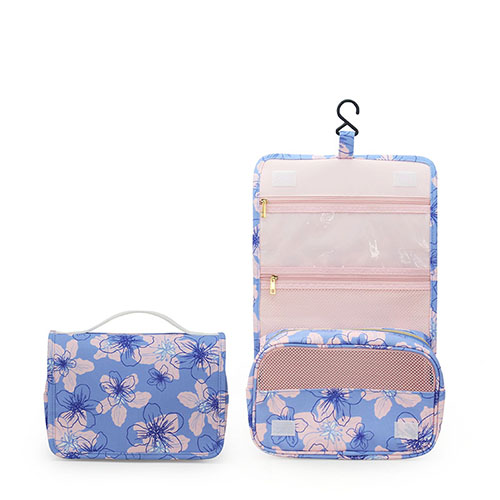
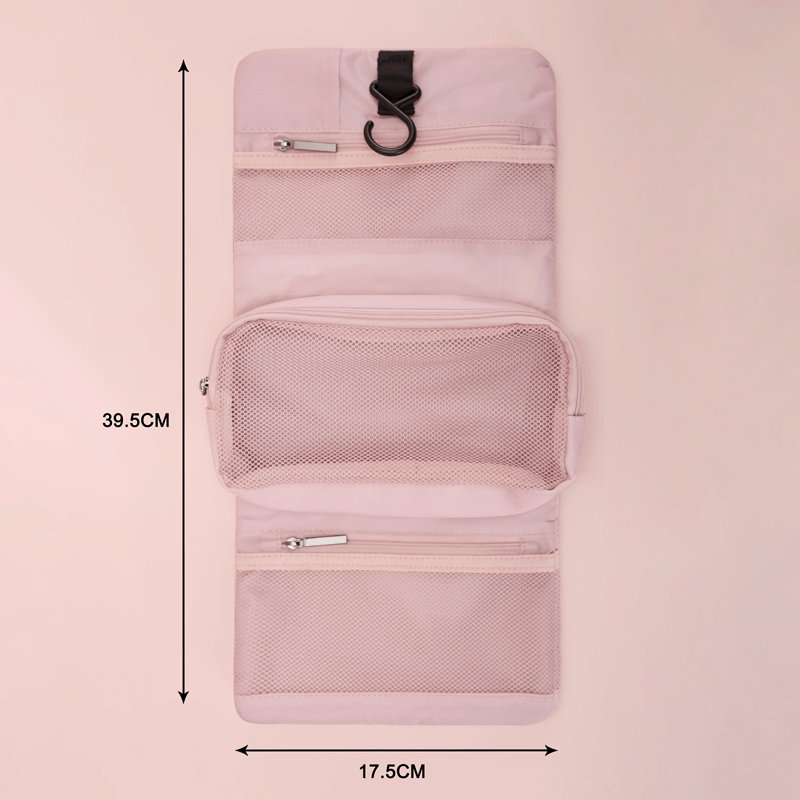
Fixed pockets, elastic loops, zipped sections and sewn dividers stay with the main bag. They work well when the assortment is stable and every item has a predictable place. Rivta's Travel & Toiletry Bags capability page shows examples of fixed mesh pockets, internal zipped sections and bottle loops.
What fixed construction can do well
A fixed layout reduces loose components during packing and use. The buyer can define a repeatable position for a bottle, brush, tube or small accessory. In a hanging design, fixed zones can also keep the open panel organized while the user sees several items at once.
The structure can be easier to communicate when the range is narrow: one main cavity, one zipped pocket and a defined set of loops may be enough. The factory can compare the approved sample against a clear pocket map without having to match a separate removable component to every unit.
What to check before approval
Fixed does not mean inflexible during development. Pocket lines, gussets and elastic positions still need to be tested against the actual contents. A stitched pocket that looks wide on a flat drawing can lose capacity when the adjacent pocket is filled. A loop can hold the nominal bottle diameter but place pressure on the cap or make removal awkward.
Ask the sample reviewer to load the bag in the intended sequence, close every zipper, hang it if the design includes a hook, and remove the highest-use item without first emptying the others. If the product assortment may change often, reserve some unassigned volume rather than fitting every cavity too tightly.
When removable inner pouches make sense
A removable pouch is useful when a defined group of items has its own handling task. The user may need to take that group to a different area, keep it separate from the main compartment, or replace the insert without replacing the outer bag. Rivta's travel and toiletry range includes layouts with detachable clear sections and smaller removable pouches; the exact construction should be agreed during development.
What the removable route can add
The strongest reason to use a removable pouch is functional separation. It can turn one large interior into a main storage area plus a portable sub-kit. A clear insert can also make the grouped contents visible, while an opaque insert can keep them visually separate. Material choice, however, does not by itself establish liquid containment or leak resistance.
Removability can also support range planning. The same outer layout might be reviewed with different insert arrangements, provided the attachment positions, loaded balance and closed dimensions still work. Treat each arrangement as a specific sample configuration rather than assuming every insert is interchangeable.
What the extra component changes
A removable insert adds interfaces that a fixed pocket does not have. The brief should identify the attachment method, attachment location, orientation and how the user releases and reinstalls the pouch. The factory also needs to know whether the bag must close when the insert is fully loaded.
Do not approve the removable pouch by itself. Check it attached, detached and reattached. Confirm that the attachment hardware does not obstruct the main opening, press against a product surface or create an uncomfortable hard point. If the insert is intended for liquids, specify the chosen construction and the agreed test separately; “removable” and “clear” are not evidence of leakproof performance.

Compare the two routes before sampling
Use the table as a decision prompt, then convert the chosen route into measurable sample checkpoints.
| Decision point | Fixed compartments | Removable inner pouches | What the buyer should provide |
|---|---|---|---|
| Primary handling task | Keep recurring items in assigned positions | Separate and lift out a defined group | Content list and use sequence |
| Configuration | Stays with the outer bag | Adds one or more separate components | Layout drawing with each component named |
| Access review | Test reach when neighboring pockets are filled | Test release, removal and reattachment | Loaded photos or a review video |
| Space review | Check pocket opening and usable depth | Check insert capacity plus the space it consumes in the bag | Representative items and acceptable closed profile |
| Cleaning brief | Identify which fixed surfaces need access | Identify whether the insert is removed for cleaning | Material and care expectations |
| Production reference | Pocket map and approved main sample | Main sample plus approved insert and attachment details | Version-controlled sample notes |
The two routes can also be combined. A bag may use fixed loops for bottles and one removable pouch for a smaller group. A hybrid layout is useful only when each zone has a clear job. Adding more components without a handling reason can make the sample harder to evaluate and the user experience more complicated.
Specify the attachment and usable space
“Add a removable pouch” is not a complete instruction. The RFQ or development sheet should show the pouch in context and state how it connects to the main bag. The supplier needs enough information to build and quote one defined configuration.
Attachment details to place on the drawing
Identify the attachment type selected for the project, the number and position of connection points, the opening direction and the intended removal motion. Mark the pouch orientation so a clear window, zipper or label does not face the wrong way after assembly. If the design uses hardware, confirm its material and finish as part of the bill of materials rather than leaving it as a visual assumption.
Dimensions that affect real capacity
Give external component dimensions, but review internal usable space as well. Seams, bindings, gussets, padding and the attachment zone can reduce the space available to the contents. State whether a listed dimension refers to a finished external measurement or a required usable cavity. For irregular bottles, a simple outline drawing or physical reference can be more useful than one diameter.
Also check the outer bag after loading. A removable insert that fits on its own may make the finished bag too bulky to close or may shift the center of weight when hung. These are sample decisions, not details to postpone until bulk production.
Approve the loaded layout, not the empty bag
The approval record should connect the layout drawing, sample version and review evidence. Rivta's toiletry bag sample approval checklist covers bottle fit, hook, lining and packing checks; add the following layout-specific checks for this project:
- Photograph the approved contents beside the empty bag so the reference set is visible.
- Load every intended item and record where it belongs.
- Open and close all pockets and the outer zipper with the bag fully loaded.
- Remove the highest-use item without unloading unrelated items.
- For a removable insert, detach and reinstall it while loaded.
- Hang the bag in the intended orientation if the design includes a hook.
- Record any approved empty space, compression or movement instead of treating it as an undocumented exception.
Approval language should identify what was reviewed. “Layout approved” is weaker than “sample version B approved with the listed reference contents and attached pouch in the marked position.” If the content set, pouch dimensions or attachment changes later, assess the affected areas again before production release.
What to include in the RFQ
Send a compact layout package rather than a mood board alone:
- outer bag drawing and closed dimensions;
- named list of fixed and removable components;
- content map with item dimensions and approximate filled weights;
- pocket openings, usable-depth requirements and access priorities;
- removable-pouch attachment method, position and orientation;
- selected materials, lining, closure and hardware references;
- logo position on the outer bag and any insert;
- target packing state, including whether inserts arrive attached or packed separately;
- sample checkpoints and the person authorized to approve them;
- version number and date for every revised layout.
This brief lets the supplier discuss feasibility and quotation around one configuration. It also gives the buyer a clear basis for comparing the sample with the approved intent.
Planning a custom toiletry bag layout?
Send Rivta your content map, preferred layout route and target use. We can review the brief for fixed compartments, removable inserts and the sample checkpoints that should be confirmed before production.
Buyer questions
Is a removable pouch always more flexible than fixed pockets?
It creates a separate component, but flexibility depends on the use case. If the assortment and access order are stable, fixed compartments may be simpler. Choose the removable route only when separating or lifting out a group has a clear value.
Can a detachable clear pouch be described as leakproof?
Not from appearance or material name alone. Liquid containment depends on the selected material, seams, closure and the agreed test method. Define and verify that requirement separately.
Can fixed and removable storage be combined?
Yes. A hybrid layout can use fixed zones for recurring items and a removable pouch for one defined group. The loaded sample should confirm that the combination still closes, balances and allows access.
What is the most useful approval evidence?
A versioned layout drawing plus photos or video of the approved sample loaded with the reference contents. The evidence should show access, closure and any removable component attached and detached.
Rivta references used
- Travel & Toiletry Bags capability page — current descriptions of fixed and detachable layout options.
- TRA034 fold-out toiletry bag — visible fixed storage-zone reference.
- CBR312 hanging organizer — visible multi-level layout reference.
About the Author

WRITTEN BY JOLIAN LU, SEO MANAGER
Hi there! I'm a mom to an awesome eleven-year-old boy. I started in this business as a fresh-faced graduate and now lead Rivta-Factory's SEO and content work. Here to share my passion for sustainability and building a business that cares. Let's grow together!
